Your Roadmap to Passing the CSLB Exam

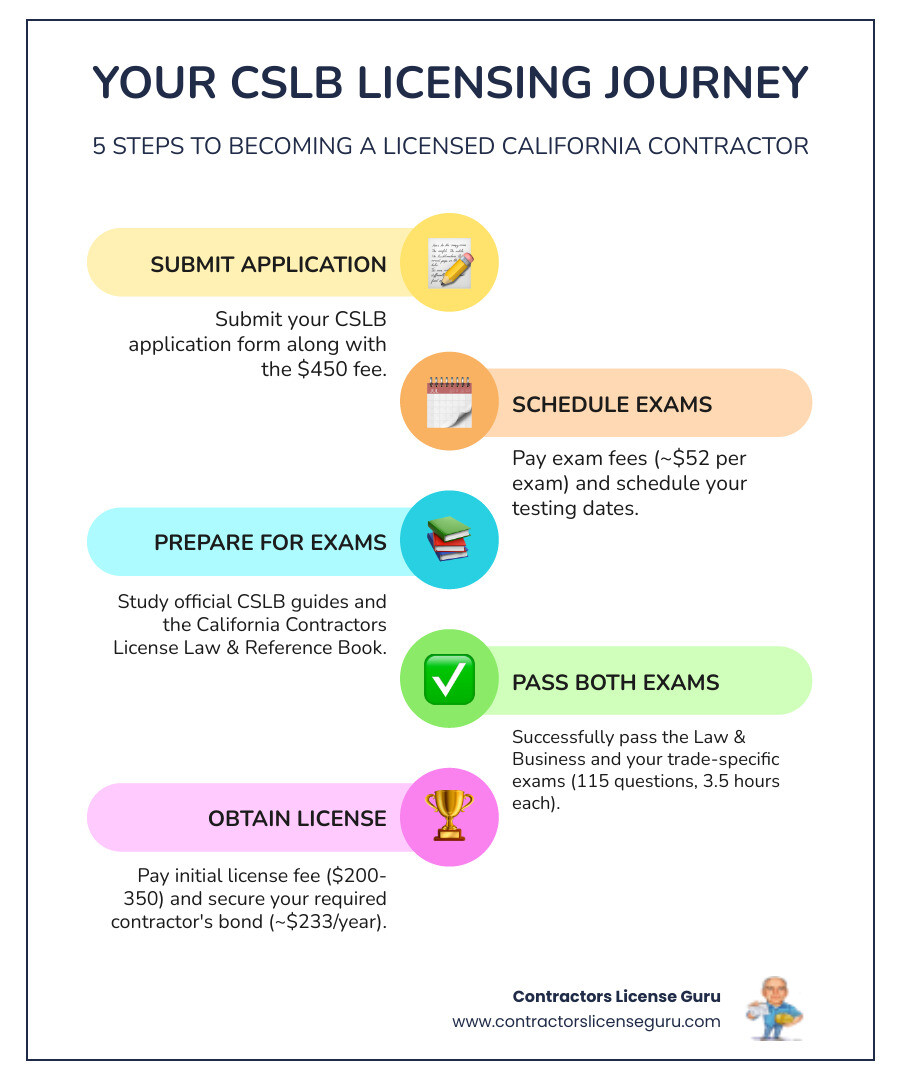
CSLB test prep requires understanding a two-part examination process and using the right study resources. Here’s what you need to know:
Quick Guide to CSLB Exam Preparation:
- Two Required Exams – All applicants must pass the Law and Business exam, plus a trade-specific exam (except C-61 Limited specialty)
- Exam Format – Multiple-choice questions with 115 questions and 3.5 hours per exam
- Total Costs – Budget approximately $450 (application) + $103 (both exams) + $75 (fingerprinting) + $200-$350 (license fee)
- Study Materials – California Contractors License Law & Reference Book, official study guides, and trade-specific resources
- Exam Policy – Closed-book, one best answer per question, calculator provided, no penalty for guessing
Getting your California contractor’s license starts with passing the CSLB examinations. The process can feel overwhelming, but it doesn’t have to be. The exam structure is straightforward: you’ll take two multiple-choice tests covering business law and your specific trade.
The Law and Business exam tests your knowledge across seven major areas, from business organization to safety requirements. Your trade exam focuses on the technical skills for your specific classification, whether that’s General Building (B), Electrical (C-10), or another specialty. Both exams are closed-book with 115 questions each, and you’ll have three and a half hours to complete them.
Understanding the exam structure is half the battle. The other half is knowing what to study and how to prepare effectively. The CSLB provides official study guides that break down each topic area by percentage weighting, so you know exactly where to focus your time.
I’m Phil Cocciante, and I spent five years as a license application technician at the CSLB before founding Contractors License Guru in 2005. Over the past 20 years, I’ve helped thousands of contractors steer the licensing process, and I’ve seen what separates those who pass from those who struggle with their CSLB test prep.
Understanding the CSLB Examination Structure and Costs
Starting on your journey to become a licensed contractor in California means getting familiar with the California Contractors State License Board (CSLB) examination process. It’s a critical step, and we’re here to explain it for you. Think of it as your first major project: understanding the blueprint before you start building.

The CSLB examination isn’t just one test; it’s a comprehensive assessment designed to ensure you’re ready to manage a contracting business and perform your trade safely and competently. This means understanding not only the practical aspects of your craft but also the legal and financial responsibilities that come with holding a contractor’s license.
The examinations are structured as closed-book, multiple-choice tests. Each question will present you with four choices, but only one is the BEST answer. Our goal is to help you confidently identify that best answer every time. Don’t worry about being penalized for guessing; there’s no penalty, so it’s always better to make an educated guess than to leave a question blank. And for those math-heavy questions, a calculator will be provided, so no need to bring your own!
The Two-Part Examination Process
At the heart of the CSLB licensing process are two main examination components that almost all qualifying individuals must conquer. This two-part approach ensures a well-rounded assessment of your capabilities.
First, everyone, regardless of their specialty, must pass the standard Law and Business examination. This test focuses on the essential business management and construction law knowledge required to operate a compliant and successful contracting business in California. It’s about ensuring you understand the rules of the game before you step onto the field.
Second, with one specific exception, qualifying individuals must also pass a second test. This is your trade-specific examination, covering the particular trade or certification area for which you are applying. This part of the exam digs into the technical skills and knowledge unique to your chosen craft, whether you’re a general builder, an electrician, a plumber, or another specialized contractor.
The exception to the trade-specific test is for the C-61 Limited specialty classification. If you’re applying for this specific license, you’re off the hook for the trade exam, but the Law and Business exam is still a must!
These standardized tests are developed with the assistance of industry experts—real contractors who know what it takes to succeed in the field. This means the questions are practical and relevant to real-world scenarios you’ll encounter on the job.
CSLB Licensing and Examination Costs
We understand that pursuing your contractor’s license is an investment, both in time and money. Knowing the approximate costs upfront can help you budget effectively for your CSLB test prep journey. Here’s a breakdown of the typical fees you can expect:
| Fee Type | Approximate Cost | Details |
|---|---|---|
| State Application Fee | $450.00 | This fee is paid when you submit your initial application to the CSLB. |
| Examination Fees | $51.43 per exam | You’ll pay this for each exam you take (Law and Business, and your Trade exam). So, roughly $102.86 for both. |
| Fingerprinting | ~$75.00 | Required for background checks, this cost can vary slightly depending on the live scan provider. |
| Initial License Fee (Sole-Ownership) | $200.00 | This is paid after you pass your exams and before your license is issued. |
| Initial License Fee (Corp/Partners/JV/LLC) | $350.00 | A slightly higher fee for business entities other than sole proprietorships. |
| Contractor’s Bond | ~$233.00 per year | An ongoing cost, this bond is required to protect consumers. The cost can vary based on your credit. |
As you can see, the total cost can add up, but it’s an investment in your future as a licensed California contractor. We help you steer these financial aspects, ensuring you’re prepared for each step.
Mastering the Law and Business Examination
The Law and Business examination is a cornerstone of your CSLB test prep. This exam is designed to ensure that you, as a future contractor, have a solid understanding of the business management and construction law principles necessary to run a compliant and successful operation in California. It’s not just about swinging a hammer; it’s about understanding the entire framework within which you’ll operate.
This exam is a multiple-choice test, typically consisting of 115 questions, and you’ll have three and a half hours to complete it. The questions are randomly mixed but cover seven major topic categories. Knowing these categories and their approximate weighting will be crucial for focusing your study efforts.
Essential Study Resources for Your CSLB Test Prep
Preparing for the Law and Business examination requires reliable and comprehensive study materials. We’ve identified the primary resources that will be your best friends during this phase of your CSLB test prep:
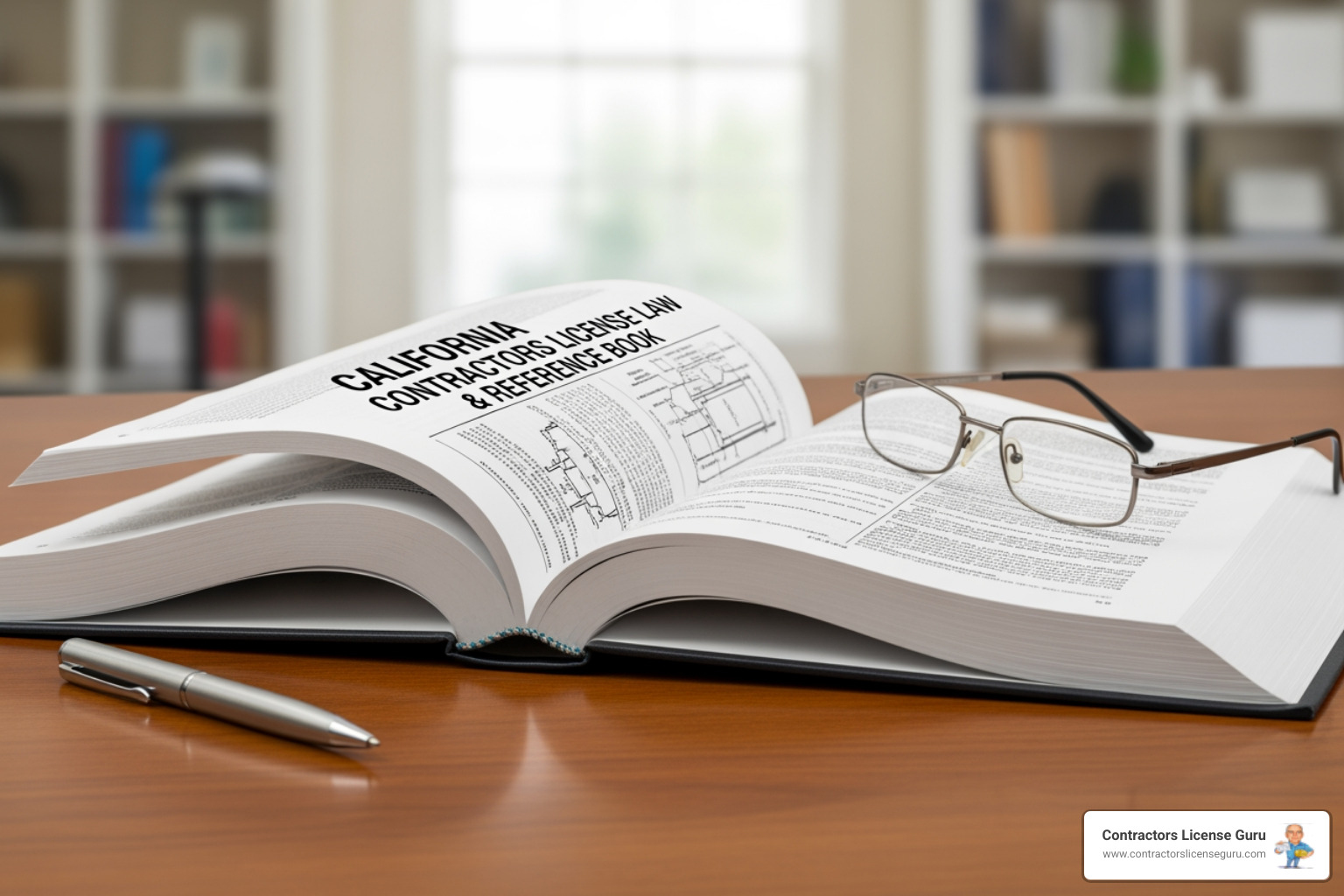
- The California Contractors License Law & Reference Book: This is the absolute basic study reference for the Law and Business exam. It’s a treasure trove of information covering everything from licensing requirements to contract provisions. While it’s indispensable, it’s not sold at CSLB offices, so you’ll need to acquire it elsewhere.
- Official CSLB Study Guides: When you receive your “Notice to Appear for Examination,” it will include a study guide specifically for the Law and Business examination. These guides are invaluable as they list the topic areas covered, show how each area is weighted, and recommend additional resource materials.
- Employer’s Guides from State and Federal Tax Agencies: These guides, such as Publication 15, Employer’s Tax Guide, offer crucial information on employment requirements, payroll, and taxes are all key components of the exam.
- Materials on Business Management and Construction Law: Beyond the CSLB’s specific recommendations, general materials focusing on these areas can deepen your understanding. Look for resources that align with California’s specific legal and business environment.
- Online Code Books: Many California code books, which are referenced in the exam, can be viewed online. For example, you can find official California code books online at www.dgs.ca.gov/bsc.
Key Topics and Weightings to Focus On
The Law and Business Examination is divided into seven major sections, each with an approximate weighting, helping you prioritize your study time. Here’s how they break down:
- Business Organization and Licensing (13%): This covers company organization, licensing requirements, advertising standards, and subcontracting rules. It’s about understanding the foundational legal structure of your business.
- Business Finances (15%): Expect questions on cash management, budgeting, financial planning, taxes, and financial reporting. This section ensures you grasp the fiscal responsibilities of running a contracting business.
- Employment Requirements (20%): This is a significant portion, focusing on hiring, supervising, training, evaluating employees, record-keeping, and payroll. Understanding labor laws is paramount for any employer.
- Insurance and Liens (12%): Topics here include workers’ compensation insurance, general business insurance, and the intricacies of liens and other legal remedies. Protecting your business and understanding your rights and obligations regarding payments are key.
- Contract Requirements and Execution (21%): The largest section, it digs into bidding processes, cost control, project organization, contract drafting, and payment procedures. This is where the rubber meets the road in project management.
- Public Works (5%): Though a smaller percentage, this section is vital if you plan to work on government projects, covering prevailing wage requirements, bonding, and specific insurance needs for public works.
- Safety (14%): This critical area addresses training and reporting requirements, general safety protocols, and handling hazardous materials. Safety isn’t just good practice; it’s a legal obligation.
By focusing your CSLB test prep on these areas according to their weighting, you’ll be strategically positioning yourself for success.
Acing Your Specific Trade Examination
Once you’ve wrapped your head around the Law and Business side of things, it’s time to dive into the specifics of your chosen craft. Acing your trade examination is where your practical experience truly shines. This test is all about confirming your hands-on knowledge and understanding of industry best practices, safety, and codes.
Like the Law and Business exam, trade examinations are multiple-choice. What sets them apart is their focus on trade-specific knowledge, often requiring you to interpret blueprints, technical drawings, or other project documents. Don’t be surprised if some questions refer to accompanying booklets containing drawings or plans. This is the CSLB’s way of testing your ability to read and understand the critical documents you’ll encounter on job sites.
When you receive your “Notice to Appear for Examination,” it will come with a study guide custom to your specific trade or certification. This guide is your roadmap, outlining the exact topic areas covered, their percentage weightings, and recommended resource materials. We always advise our clients to treat this guide as their bible for CSLB test prep for the trade exam.
Breakdown of the General Building (B) Exam
If you’re aiming for a General Building (B) contractor’s license, your trade exam will cover a broad spectrum of construction knowledge. This license is for contractors whose primary business is in connection with any structure built, being built, or to be built, requiring in its construction the use of more than two unrelated building trades or crafts. It’s truly a generalist’s license!
The General Building (B) Examination is divided into five major sections, each focusing on a different aspect of building construction:
- Planning and Estimating (15%): This section tests your ability to plan projects, interpret plans and specifications, and accurately estimate costs and materials. Think about site preparation, layout, and understanding project scope.
- Framing and Structural Components (20%): A significant portion of the exam, this covers everything from foundations and slabs to rough framing, decks, and seismic reinforcement. You’ll need to know about different materials and structural integrity.
- Core Trades (30%): This is the largest section, encompassing a wide range of essential building trades. Expect questions on plumbing, electrical, HVAC, concrete work, earthwork, insulation, and roofing. While not as detailed as a specialty trade exam, you need a solid general understanding of these areas.
- Finish Trades (20%): This section covers the aesthetic and functional completion of a structure, including painting, tile, flooring, cabinetry, drywall, windows, doors, and even landscaping.
- Safety (15%): Critical for any construction project, this covers personnel safety, transportation safety, and environmental safety measures. Understanding OSHA regulations and best practices is key.
You’ll also encounter questions that refer to specific codes, such as the California Residential Code. For example, a sample question might ask about the minimum allowable width of a residential hallway according to this code (the answer is 36 inches!). This highlights the importance of familiarizing yourself with relevant state building codes.
Breakdown of the Electrical (C-10) Exam
For those aspiring to be licensed electrical contractors (C-10), your trade exam will focus intensively on electrical systems, installations, and safety. This license covers the construction, fabrication, erection, installation, and repair of any electrical apparatus or appliances, and the electrical wiring for the power, heat, light, and other purposes.
The Electrical (C-10) Examination is structured into five key areas:
- Planning and Estimating (28%): This large section involves evaluating existing systems, performing electrical calculations, understanding code requirements, selecting materials, and designing system layouts. It’s about getting the project started right.
- Rough Wiring (27%): Another substantial part, covering the installation of raceways, panels, wire, and equipment, as well as grounding and bonding. This is the backbone of any electrical system.
- Finish Wiring and Trim (11%): This section focuses on the final stages, including the placement and installation of finish devices, motor and equipment installation, wire and equipment labeling, and trims and sealants.
- Startup, Troubleshooting, and Maintenance (16%): This area tests your ability to energize and test systems, identify and resolve common electrical problems, and perform repairs and replacements using appropriate testing equipment.
- Safety (18%): Safety is paramount in electrical work. This section covers lockout/tagout procedures, personal protective equipment (PPE), safe tool and equipment use, and handling hazardous materials and job site environments.
It’s worth noting that energy production and storage systems, such as photovoltaic systems, wind, generators, batteries, and capacitors, are integrated into multiple sections of this exam. For example, you might be asked about bonding and grounding requirements for roof-mounted PV systems. This reflects the evolving nature of electrical work and the increasing demand for sustainable energy solutions.
Both trade exams, like the Law and Business exam, are developed and reviewed by actively working licensed contractors. This means the questions are grounded in real-world scenarios and reflect the current demands of the industry.
Your Complete CSLB Test Prep and Exam Day Strategy
Preparing for the CSLB examinations is more than just memorizing facts; it’s about developing a comprehensive strategy that covers your study habits, mental preparation, and actual test-taking skills. We want to see you walk into that test center with confidence and walk out with success!
Before the Exam: Finalizing Your CSLB Test Prep
The weeks and days leading up to your exam are crucial for solidifying your knowledge and boosting your confidence. This is where our CSLB test prep expertise truly comes into play.
- Use Practice Exams: This is perhaps the single most effective tool for your preparation. Our comprehensive practice exams are designed to simulate the actual CSLB examinations. They offer targeted questions and detailed explanations, helping you not just find the right answer, but understand why it’s the right answer.
- Assess Your Knowledge: Practice exams aren’t just for practice; they’re diagnostic tools. Use them to honestly assess your current knowledge level. Where are you strong? Where do you struggle?
- Identify Weak Areas: Once you’ve assessed your knowledge, pinpoint the specific topics or sections where you consistently make mistakes. This allows you to focus your remaining study time precisely where it’s needed most, rather than re-reviewing what you already know.
- Boost Confidence: The more practice you get, and the more you see yourself answering questions correctly, the more confident you’ll become. Confidence is a powerful asset on exam day, reducing anxiety and improving performance.
- Review Key Concepts: Don’t just re-read your notes. Actively review the key concepts, formulas, and regulations. Try explaining them aloud or teaching them to someone else – this helps reinforce your understanding.
The goal of this final stage of CSLB test prep is to ensure you’re fully prepared, not just to pass, but to pass with flying colors.
On the Day of the Test: Strategies for Success
The big day has arrived! All your hard work in CSLB test prep culminates here. While knowledge is key, your approach on exam day can significantly impact your performance. Here are our best strategies for success:
- Arrive On Time: This sounds simple, but it’s critical. Plan to arrive at the test center early to avoid any last-minute stress. Being on time means being calm and ready.
- Bring Valid ID: Don’t forget your identification! You won’t be admitted to the exam without proper, valid identification.
- Eat a Healthy Breakfast: Fuel your brain! A nutritious meal before the exam will provide sustained energy and help you focus. Avoid heavy, sugary, or unfamiliar foods that might upset your stomach.
- Stay Calm and Methodical: It’s natural to feel some nerves, but try to maintain a calm and methodical approach. Take a few deep breaths if you feel overwhelmed. You’ve prepared for this!
- Manage Your Pace: With 115 multiple-choice questions and three and a half hours, time shouldn’t be a major issue if you manage your pace effectively. Don’t dwell too long on any single question.
- Answer Known Questions First: Scan through the exam and answer all the questions you know immediately. This builds momentum and ensures you secure easy points.
- Mark Difficult Questions for Review: For questions that trip you up, make your best guess and “mark” them for later review if the exam software allows. This way, you can move on without losing too much time and come back to them if you have extra minutes at the end. Since there’s no penalty for guessing, always choose an answer.
By following these strategies, you’re not just relying on your knowledge; you’re optimizing your performance under exam conditions.
Conclusion: Take the Next Step in Your Contractor Journey
Navigating the CSLB licensing process, especially the examinations, can seem like a daunting task. However, with the right CSLB test prep strategy and reliable resources, it’s an entirely achievable goal. We’ve walked through the two main components of the examination, the Law and Business exam and your specific trade exam, and highlighted the key topics, weightings, and essential study materials for each. We’ve also covered the associated costs and provided practical tips for exam day success.
Your journey to becoming a licensed contractor in California is a significant step towards building your professional future. We believe that thorough preparation is the cornerstone of passing these exams with confidence. At Contractors License Guru, we’re dedicated to providing you with the expert guidance, study materials, and practice exams you need to succeed. We’ve helped countless individuals in California, including those in Sacramento, achieve their licensing goals, and we’re ready to help you too.
Ready to dive deeper into what to expect from the examination process?
Learn everything you need to know about PSI exams and take the next crucial step in your contractor journey.