
Why Every California Contractor Must Appoint a Registered Agent

When you appoint a registered agent, you’re designating an official person or company to receive legal documents and state notices on behalf of your business. Here’s what you need to know:
Quick Answer: How to Appoint a Registered Agent
- Choose your agent – Select yourself, an employee, or a professional service with a physical address in your state
- Include agent details during formation – List their name and physical address on your Articles of Organization or Incorporation
- Get agent consent – Ensure they agree to serve (required in some states like Texas)
- File with the Secretary of State – Submit your formation documents with the required fees
- Update as needed – File a Statement of Change form if you need to change agents later
Key Requirements:
- Must have a physical street address in your state (no P.O. Boxes)
- Must be available during normal business hours
- Must be 18+ years old or an authorized business entity
If you’re forming an LLC or corporation in California, or any state, state law requires you to appoint and maintain a registered agent. This isn’t optional. Without one, your business risks losing good standing, facing penalties, or even administrative dissolution. When a lawsuit arrives or the state sends a compliance deadline, that notice goes to your registered agent. Miss it because you don’t have one, and you could face a default judgment.
I’m Phil Cocciante, owner of Contractors License Guru, and in my 20+ years in the construction industry, including five years working directly at the Contractors State License Board, I’ve seen countless contractors struggle with business formation requirements, including how to properly appoint a registered agent. I’m here to walk you through this critical step so you can focus on building your contracting business, not worrying about compliance issues.
What is a Registered Agent and Why is it a Legal Necessity?
Imagine you’re building a masterpiece. You’ve got your blueprints, your crew, and your materials all lined up. But what happens if a crucial legal notice or an urgent state compliance reminder gets lost in the mail or delivered to an empty job site? That’s where a registered agent comes in.
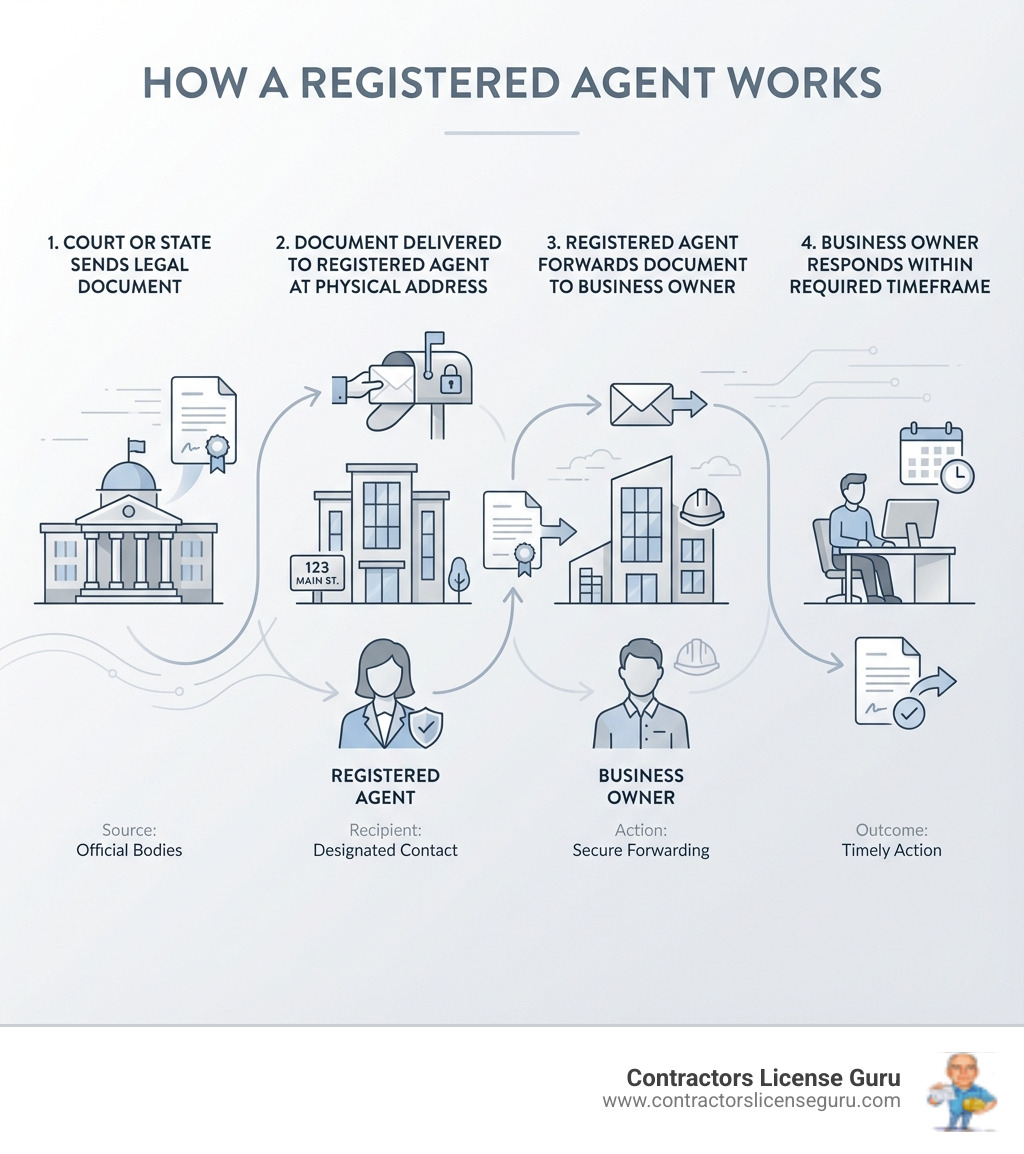
A registered agent is your business’s official legal point of contact. They are a designated individual or business entity responsible for receiving important legal documents and official state correspondence on behalf of your company. Think of them as your business’s dedicated mailbox for all things legal and governmental. This role is so vital that state law in California, and across the U.S., legally requires most formal business entities, such as LLCs and corporations, to maintain one. They may also be known as a statutory agent, resident agent, or agent for service of process, depending on the state.
Why is this a legal necessity? Because states need a reliable, consistent way to communicate with your business, especially when it comes to time-sensitive legal matters. Without a registered agent, proving that your business was properly notified of a lawsuit or a critical deadline would be nearly impossible. This requirement ensures transparency and accountability for all businesses operating within the state.

The Primary Responsibilities of a Registered Agent
The core function of a registered agent is to be available during normal business hours to accept legal and official documents. These aren’t your everyday junk mail or marketing flyers; these are critical items that demand immediate attention. Our registered agent will typically handle:
- Service of Process: This is the big one. If your business is ever sued, a process server will deliver the summons and complaint directly to your registered agent. This formal notification officially starts a lawsuit. Without a registered agent, you could miss this vital notice, potentially leading to severe consequences.
- Lawsuits and Subpoenas: Beyond the initial summons, a registered agent may receive other legal documents related to ongoing litigation, such as subpoenas for documents or testimony.
- Official State Mail: This includes annual report reminders, notices about compliance deadlines, tax notices, and other important communications from the California Secretary of State or other state agencies.
- Wage Garnishments: If an employee’s wages are garnished, the legal notice might be served to your registered agent. While only about seven percent of United States employees have their wages garnished, it’s a notice your business absolutely cannot afford to miss.
A registered agent’s job is to receive these documents and promptly forward them to you, ensuring you’re always aware of crucial legal and compliance issues. This proactive approach helps your business stay informed and compliant.
Understanding the Registered Office
The registered office is the physical street address in California where your registered agent is located and available to receive documents during normal business hours. This isn’t just any address; it has specific requirements:
- Physical Street Address: A P.O. Box is almost never acceptable. States require a physical location where someone can hand-deliver legal documents.
- Located in the State of Formation: If your business is registered in California, your registered office must be in California. If you expand your business and register in another state, you’ll need a registered agent with a physical office in that state too.
- Availability During Business Hours: The registered agent or their staff must be available at the registered office during standard business hours to accept deliveries. This ensures that legal documents can be served without delay.
- Public Record: Be aware that the address of your registered office becomes part of the public record. This is a significant consideration, especially if you’re thinking about using your home address.
Choosing the right registered office and agent is about ensuring reliability and meeting legal obligations. For more general information on this crucial role, you can refer to resources like Nolo’s explanation of What Is a Registered Agent?.
Who Can Be Your Registered Agent? Weighing the Options
When it comes to appointing a registered agent for your California business, you essentially have two main choices: designate an individual (like yourself, an employee, or a trusted contact) or hire a professional registered agent service. Each option comes with its own set of pros and cons, and the best choice often depends on your business’s specific needs and priorities.

Serving as Your Own Registered Agent
“Can I just be my own registered agent?” It’s a common question, and the answer is usually yes, provided you meet the state’s requirements. In California, you can serve as your own registered agent if you are:
- An individual residing in California.
- At least 18 years old.
- Available at a physical street address in California during normal business hours.
Pros of Being Your Own Registered Agent:
- Cost Savings: This is the primary advantage. You avoid the annual fee associated with professional services.
Cons of Being Your Own Registered Agent:
- Loss of Privacy: Your registered office address becomes a matter of public record. If you use your home address, that personal information is now easily accessible online. This can lead to unwanted solicitations, junk mail, and even process servers showing up at your doorstep.
- Availability Constraints: You must be consistently available at the registered office during standard business hours. If you travel frequently, work on job sites, or simply need to step out for a few hours, you risk missing critical documents. Missing a service of process because you were out could have dire consequences for your business.
- Junk Mail and Spam: Because your address is public, it can attract a lot of unwanted mail and calls.
- Professional Image: Having a process server show up at your home or primary business location could be awkward or unprofessional, especially if clients are present.
While being your own agent might save you a few dollars, it often comes at the expense of privacy and peace of mind. As SCORE notes, “If you’re not regularly available to accept legal notices in person at the location listed on your public documents, you should not be your own registered agent.”
Using a Professional Registered Agent Service
For many California contractors, especially those who value privacy, reliability, and efficiency, hiring a professional registered agent service is the preferred route. These services specialize in fulfilling the registered agent role, allowing you to focus on your core business.
Here’s a comparison to help you decide:
| Feature | Being Your Own Registered Agent | Professional Registered Agent Service |
|---|---|---|
| Cost | Free (no direct fee) | Annual fee (typically $99-$300 annually) |
| Privacy | Your personal/business address is public | Uses the service’s address, keeping yours private |
| Availability | Requires your constant presence during business hours | Always available during business hours, staffed by professionals |
| Reliability | Dependent on your personal availability and diligence | Ensures timely receipt and forwarding of all critical documents |
| Location | Must have a physical address in California | Provides a physical address in California (and other states if needed) |
| Mail Handling | All official mail comes to you directly | Filters out junk mail, forwards only critical documents, often with scans |
| Compliance | Requires you to track deadlines and regulations | Often provides compliance reminders and alerts |
| Multi-State | Requires a separate individual in each state you operate in | Can cover multiple states through one provider, simplifying compliance |
Advantages of Hiring a Professional Registered Agent Service:
- Privacy Protection: This is a major benefit. By using the service’s address for your registered office, your personal or primary business address stays off the public record, reducing unwanted solicitations and maintaining a professional appearance.
- Reliability and Availability: Professional services are always staffed during business hours, ensuring that no critical document is ever missed. They have systems in place to immediately notify you and forward any received correspondence.
- Peace of Mind: Knowing that a dedicated service is handling your legal notifications allows you to focus on running your contracting business without the constant worry of missing a crucial deadline or lawsuit.
- Compliance Management: Many services offer additional tools, such as compliance calendars and reminders for annual reports or other state filings, helping you stay in good standing.
- Efficiency: They handle the filtering of junk mail and quickly scan and upload important documents to your secure online portal, giving you instant access.
- Scalability: If your California business expands to other states, a national professional service can provide registered agent services in multiple jurisdictions, streamlining your compliance efforts.
- Affordable: The cost of engaging a registered agent typically ranges from $99 to $300 annually, a small price to pay for the significant benefits of privacy, compliance, and reliability. As Forbes outlines, “You can hire a registered agent service for an annual fee… This can solve many of the problems that listing yourself as your registered agent could pose.”
For California contractors, the advantages of a professional service often far outweigh the minimal cost, ensuring your business remains compliant and protected.
The Step-by-Step Guide to Appoint a Registered Agent
Whether you’re just starting your California business or need to update your existing information, the process to appoint a registered agent is straightforward once you understand the steps. It’s a critical part of your business formation and ongoing compliance.
How to Appoint a Registered Agent During Formation
When you’re establishing a new LLC or corporation in California, you’ll designate your initial registered agent as part of your formation documents. This is typically done when you file your Articles of Organization (for an LLC) or Articles of Incorporation (for a corporation) with the California Secretary of State.
Here’s how it generally works:
- Prepare Your Formation Documents: As you complete your Articles of Organization or Articles of Incorporation, you’ll encounter a section specifically for the registered agent. For assistance with forming your business entity, our team at Contractors License Guru can guide you through the process of how to Form a Corp or LLC.
- Provide Agent’s Name: You’ll need to list the full legal name of the individual or the registered name of the professional service you’ve chosen to be your registered agent.
- Provide Agent’s Physical Address: Crucially, you’ll need to provide the physical street address in California that will serve as your registered office. This cannot be a P.O. Box.
- Agent Consent (If Applicable): While California typically doesn’t require a separate, signed “Consent to Appointment” form to be filed with the Secretary of State, it’s always best practice to ensure your chosen agent has agreed to serve before you list them. Some states, like Texas, have a specific rule that registered agents designated on or after January 1, 2010, must have consented to serve in that capacity in a written or electronic form. Even if not filed, your business should retain proof of consent for its records.
- File with the Secretary of State: Once your formation documents are complete with the registered agent information, you’ll submit them to the California Secretary of State along with the required filing fees.
By correctly completing this step during formation, you ensure your business starts off on the right foot, legally compliant and ready to receive important communications.
How to Change and Appoint a New Registered Agent
Businesses evolve, and sometimes you need to change your registered agent. Perhaps your individual agent moved out of state, or you’ve decided to switch from being your own agent to a professional service. Whatever the reason, updating your registered agent information is a mandatory compliance step.
The process typically involves filing a “Statement of Change of Registered Agent” form (or a similarly named document) with the California Secretary of State.
- Obtain the Correct Form: You’ll need to download the specific form from the California Secretary of State’s website.
- Complete the Form: This form will generally require:
- Your business’s legal name and entity type.
- Your business’s entity ID or file number.
- The name and address of your current registered agent.
- The name and physical street address of your new registered agent.
- Often, the new registered agent will need to sign to indicate their consent to serve.
- Submit with Filing Fees: You’ll submit the completed form to the California Secretary of State. The fees associated with changing an appointed registered agent’s name are generally quite low, ranging from $25 to $50 in most states. These fees can vary, so always check the current fee schedule on the California Secretary of State’s website.
- Update Other Records: Once the change is processed by the state, remember to update your internal records and notify any relevant parties (e.g., your attorney, accountant).
Keeping your registered agent information current is crucial. Failure to do so can lead to missed legal notices and compliance issues, which brings us to our next point… While specific forms and fees vary by state, understanding the general process of filing forms for existing businesses can give you an idea of what to expect.
The Critical Consequences of Non-Compliance
Ignoring the registered agent requirement is like playing Russian roulette with your business. It might seem like a small detail, but the repercussions of failing to maintain a valid registered agent or providing inaccurate information can be severe, potentially jeopardizing your entire operation.
What Happens if You Don’t Have a Registered Agent?
If your California business fails to maintain a registered agent or if your agent’s information becomes inaccurate (e.g., they move without updating their address), you face a cascade of serious problems:
- Loss of Good Standing: The California Secretary of State will consider your business to be “not in good standing.” This can prevent you from obtaining necessary permits, entering into contracts, or even expanding your business.
- Fines and Penalties: States often impose monetary fines and penalties for non-compliance. These can add up quickly and become a significant burden.
- Administrative Dissolution or Revocation: If you remain non-compliant for an extended period, the state can administratively dissolve your LLC or revoke your corporation’s authority to do business. This means your business legally ceases to exist in the state, losing its liability protections and other benefits.
- Inability to Sue or Defend: A business not in good standing might lose its ability to file lawsuits or defend itself in court. Imagine being unable to collect on a debt or respond to a legal claim!
- Default Judgment: This is perhaps the most frightening consequence. If your business is sued and you don’t have a valid registered agent to receive the service of process, you might never know about the lawsuit. The court can then issue a “default judgment” against your business, meaning the plaintiff automatically wins the case because you failed to respond. This can lead to significant financial losses, damage to your business’s reputation, and even asset seizure, all without your knowledge until it’s too late.
- Piercing the Corporate Veil: In extreme cases of non-compliance, courts might “pierce the corporate veil,” holding individual owners personally liable for the business’s debts and obligations. This completely negates the liability protection that an LLC or corporation is designed to provide.
Simply put, a valid registered agent is your business’s first line of defense against missed deadlines and legal disasters. Don’t let a simple oversight expose your hard-earned business to such risks.
Frequently Asked Questions about Registered Agents
We’ve covered a lot of ground, but you might still have some specific questions buzzing around your head. Let’s tackle some of the most common ones we hear from California contractors.
Do I need a registered agent in every state where I do business?
Yes, if your California business decides to expand and “foreign qualify” to transact business in another state, you will need to appoint a registered agent with a physical address in that state. This means if you’re a California LLC and you decide to open an office or consistently perform work in, say, Nevada, you’d need a registered agent in Nevada as well as in California. Each state requires a local point of contact for legal and official communications. A national registered agent service can be incredibly helpful in managing this requirement across multiple jurisdictions.
Is a registered agent liable for my business’s debts?
No, generally, a person or entity designated as a registered agent is not liable for the debts, liabilities, or obligations of your business solely because of their designation. Their role is strictly to accept and forward documents. While laws can vary by state, this principle is widely held. For example, Section 5.208 of the Texas Business Organizations Code specifically states this for entities in Texas. The registered agent is a messenger, not a guarantor or a partner in your business’s financial dealings.
Can I use a P.O. Box for my registered agent?
No, almost universally, states require your registered agent to have a physical street address for the registered office. This is because legal documents, especially service of process, often need to be hand-delivered. A P.O. Box does not allow for this type of physical delivery. So, whether you’re using your own address or a professional service’s, ensure it’s a legitimate street address where someone can be present during business hours.
Conclusion
Appointing a registered agent is more than just a bureaucratic checkbox; it’s a foundational step for protecting your California business, ensuring its compliance, and maintaining its professional integrity. From safeguarding your privacy to acting as your reliable legal alarm system, a registered agent plays a mission-critical role.
As we’ve explored, whether you choose to serve as your own agent or opt for a professional service, the key is to understand the requirements, responsibilities, and the severe consequences of non-compliance. For California contractors, staying on top of these details allows you to focus on what you do best: building and growing your business.
We at Contractors License Guru are committed to helping you steer the complexities of business formation and licensing. If you’re ready to make the right choice for your business’s registered agent needs, learn more about our dedicated Resident Agent Service. We’re here to simplify compliance, protect your privacy, and ensure your business is always in good standing.