Why Understanding LLC Contractor License Rules Matters for California Contractors
An llc contractor license in California requires specific steps beyond what sole proprietors face, including registration with the Secretary of State, higher bonding requirements, and mandatory liability insurance. Here’s what you need to know:
Key Requirements for LLC Contractor Licenses:
- Registration: Must be registered with California Secretary of State and in good standing
- Bonds: $25,000 contractor bond PLUS $100,000 LLC employee/worker bond
- Insurance: Minimum $1 million liability insurance (increases with more personnel)
- Qualifying Individual: Must designate a Responsible Managing Member, Manager, Officer, or Employee
- Fees: $450 application fee + $350 initial license fee for non-sole owners
- Personnel: All officers, members, and responsible managers must be listed and fingerprinted
When Senate Bill 392 authorized the Contractors State License Board (CSLB) to issue licenses to limited liability companies, it opened new doors for contractors who wanted the liability protection of an LLC. But it also created unique requirements that differ significantly from sole proprietorships or corporations.
Nearly half of all CSLB applications are returned for being incomplete or inaccurate, causing delays of weeks or even months. For LLC applicants, the complexity increases because you’re managing both state business registration and contractor licensing simultaneously. Missing a single requirement—like the $100,000 employee/worker bond specific to LLCs—can halt your entire application.
The stakes are high. Contracting without a proper license for work over $1,000 can result in misdemeanor charges, fines up to $5,000, and administrative penalties reaching $15,000. And if your LLC falls out of good standing with the Secretary of State, individual members can face personal liability up to $1 million per person.
I’m Phil Cocciante, and I’ve spent over 20 years helping contractors steer CSLB requirements, including five years working directly at the Contractors State License Board as a license application technician. Since founding Contractors License Guru in 2005, I’ve guided thousands of contractors through the llc contractor license process, ensuring every bond, insurance policy, and personnel record meets CSLB standards. This guide breaks down exactly what you need to do to get your LLC licensed correctly the first time.
Why Form an LLC for Your Contracting Business?
Establishing a Limited Liability Company (LLC) for your contracting business in California offers significant advantages, primarily centered around protecting your personal assets and enhancing your business’s credibility. While the process for obtaining an llc contractor license can be more involved than for a sole proprietorship, the benefits often outweigh the additional steps.

The Advantage of Limited Liability
The main reason many contractors choose an LLC structure is the limited liability protection it provides. This means your personal assets—like your home, car, and personal savings—are generally shielded from business debts, lawsuits, or claims against your company. If your business faces financial trouble or a legal challenge, creditors and plaintiffs can typically only go after the assets held by the LLC, not your personal property. This separation of business and personal finances can bring immense peace of mind.
Consider this: If you operate as a sole proprietor and your business is sued, your personal assets could be at risk. With an LLC, that risk is significantly reduced. However, it’s crucial to maintain this separation properly; mixing personal and business finances (“piercing the corporate veil”) can negate these protections.
Beyond liability, LLCs offer flexibility in taxation, allowing for “pass-through” taxation where profits and losses are passed directly to the owners’ personal income without being taxed at the business level first, similar to a sole proprietorship or partnership. You can even elect for your LLC to be taxed as an S-Corporation for potential tax savings on self-employment taxes, a topic we cover in more detail at More info about S Corporations and Salaries.
Comparing Business Structures
When starting a contracting business, choosing the right legal structure is one of the first and most important decisions. Let’s briefly compare the options:
- Sole Proprietorship: This is the simplest structure, where you and your business are legally one entity. Easy to set up, but offers no personal liability protection.
- Partnership: Similar to a sole proprietorship but involves two or more owners. It can be easy to form but also typically lacks personal liability protection for its partners.
- Corporation: A separate legal entity from its owners, offering strong liability protection. However, corporations have more complex setup and compliance requirements, including double taxation in some cases (unless electing S-Corp status).
- Limited Liability Company (LLC): This structure combines the liability protection of a corporation with the simpler, pass-through taxation of a sole proprietorship or partnership. It’s often seen as the best of both worlds for small to medium-sized businesses.
Choosing the right entity involves weighing liability, taxation, administrative burden, and future growth plans. We have extensive resources to help you decide, including Comparing Corporations to Sole Proprietorships and Corp vs LLC.
If you’re still on the fence, our guide Should I Form a Limited Liability Company? dives deeper into this decision.
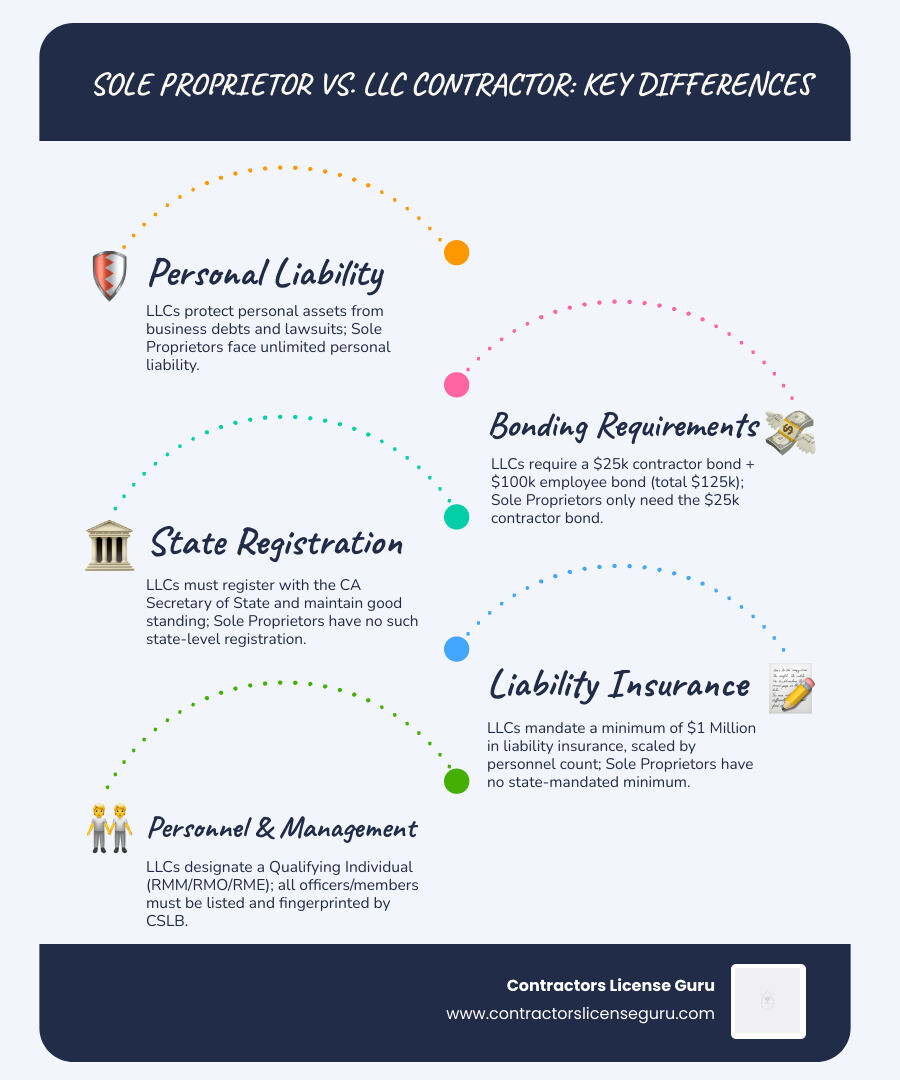
| Feature | Sole Proprietorship | Limited Liability Company (LLC) |
|---|---|---|
| Liability | Personal assets at risk | Personal assets protected |
| Taxation | Pass-through to owner’s income | Pass-through to owners’ income (can elect S-Corp) |
| CSLB Bonds | $25,000 Contractor Bond | $25,000 Contractor Bond + $100,000 LLC Employee/Worker Bond |
| CSLB Insurance | Not required (unless employees) | Minimum $1M liability insurance mandatory |
| Personnel | Owner is the primary personnel | Officers, members, managers must be listed & fingerprinted |
| State Reg. | None (unless DBA) | CA Secretary of State registration & good standing required |
For those ready to make the leap, understanding the nuances of how to form a corporation or LLC is critical. We can help you steer this process at More info about forming a corp or LLC.
The California LLC Contractor License: Key Requirements
Obtaining an llc contractor license in California involves a specific set of requirements mandated by the Contractors State License Board (CSLB) and the California Secretary of State. These requirements stem from Senate Bill 392, which authorized the CSLB to license LLCs, and are outlined in various sections of the California Business and Professions Code.
Business Entity Registration and Naming
Before you can even apply for an llc contractor license, your Limited Liability Company must be officially registered with the California Secretary of State and be in good standing. This isn’t just a formality; if your LLC’s registration is suspended or not current, it can lead to your contractor’s license being suspended, and crucially, expose your personal assets to liability, potentially up to $1 million per person.
When naming your LLC, the name must end with “Limited Liability Company” or “LLC” (or “L.L.C.”). There are also certain words, like “bank,” “trust,” “incorporated,” or “insurer,” that are prohibited from being part of an LLC’s name. The CSLB also requires your business name to be compatible with the classification(s) you’re seeking. For instance, “ABC123 Tile” would be fine for a C-54 Ceramic and Mosaic Tile license, but not for a C-10 Electrical license. We can help you steer these naming conventions and fictitious business name requirements at Contractors Business Name Style. If you plan to operate under a name different from your legal LLC name, you might also need to file a “Doing Business As” (DBA), which we explain further in Do I Need a DBA?. For detailed information on LLC business name issues and registration, you should always Contact the Secretary of State’s office.
The Role of the Qualifying Individual
Every llc contractor license must have a “qualifying individual” who meets the experience and examination requirements and is responsible for the company’s construction operations. For an LLC, this can be a:
- Responsible Managing Member (RMM)
- Responsible Managing Manager
- Responsible Managing Officer (RMO) (if the LLC has elected to have officers)
- Responsible Managing Employee (RME)
This individual must have at least four years of journey-level experience (or higher) in the classification being applied for, obtained within the last ten years. “Journey-level” means they are a skilled worker capable of performing the trade without supervision or have completed an apprenticeship program. This experience must be verifiable, often through payroll records or similar documents.
The qualifying individual is the heartbeat of your licensed operations. They ensure your LLC adheres to CSLB laws, rules, and regulations. They must be actively engaged in the operation of the business, typically working at least 32 hours per week or 80% of the total business operating hours, whichever is less, if they are an RME. Their expertise is what the CSLB trusts to uphold construction standards. We prepare you for this step, including what to expect during the examination process, at What to Expect on Test Day.
Special Bonding and Insurance Mandates for LLCs
Here’s where the llc contractor license requirements truly diverge from other business structures. LLCs face additional financial mandates designed to protect consumers and employees:
- $25,000 Contractor Bond: Like all licensed contractors in California, your LLC must file a $25,000 surety bond with the CSLB. This bond protects consumers who may suffer damages due to the contractor’s actions.
- $25,000 Bond of Qualifying Individual: If your qualifying individual (RMO, RMM, or Responsible Managing Manager) holds less than 10% of the membership interest in your LLC, an additional $25,000 bond of qualifying individual is required. This applies to RMEs regardless of their ownership stake.
- $100,000 LLC Employee/Worker Bond: This is unique to LLCs. Active llc contractor license holders must file an additional $100,000 surety bond. This bond specifically benefits any employee or worker who may be damaged by the LLC’s failure to pay wages, interest on wages, or fringe benefits.
- Liability Insurance: LLCs are legally required to carry specific liability insurance. The minimum aggregate limit is $1 million for LLCs with five or fewer persons listed as personnel of record. For each additional personnel, an extra $100,000 in coverage is required, up to a maximum of $5 million total. This insurance must be from an insurer duly licensed by California or an eligible surplus line insurer.
- Workers’ Compensation Insurance: If your LLC has employees (even just one, including an RME), you must provide proof of workers’ compensation insurance or a certificate of self-insurance. Even if you don’t have employees, certain classifications (like roofing or asbestos abatement) require it.
These bonding and insurance requirements are non-negotiable for an llc contractor license and must be maintained to keep your license active. Failure to do so will result in license suspension. You can find licensed insurers through the California Department of Insurance, and we encourage you to Find an insurer via the Department of Insurance.
For comprehensive details on these specific requirements, refer to the CSLB’s official page on Licenses for Limited Liability Companies (LLC).
Step-by-Step: Applying for Your California License
Getting your California llc contractor license can feel like navigating a maze, but breaking it down into manageable steps makes the process much smoother. The CSLB application process is thorough, and attention to detail is key to avoiding delays.
Preparing and Submitting Your CSLB Application
The journey begins with the “Application for Original Contractor License.” We’ve seen that nearly half of all applications submitted to the CSLB are returned for inaccuracies or incompleteness. This is why careful preparation is so important!
Here’s what you’ll need to focus on:
- Application Form: Complete all sections accurately and legibly. Make sure your LLC’s name is correct and consistent with your Secretary of State registration.
- Work Experience Verification: The qualifying individual must document four years of journey-level experience within the last 10 years. This is done on the “Certification of Work Experience” form and must be certified by someone with direct knowledge of the experience, verifiable through payroll records or similar documents.
- Criminal Background Check: All personnel of record (officers, members, responsible managers, or directors) for your LLC must submit fingerprints for a criminal background check through Live Scan. Even if you’ve been fingerprinted before for another agency, you’ll need to do it again for CSLB. Don’t worry if you have a past conviction; it doesn’t automatically disqualify you. CSLB reviews each case individually, considering the nature of the crime, time passed, and evidence of rehabilitation.
- Fees: The non-refundable application fee is $450. The initial license fee ($350 for non-sole owners like LLCs) is paid after you pass your examinations.
We guide you through every line of the application, ensuring completeness and accuracy. For a detailed walkthrough, check out our comprehensive guide on CSLB’s guide to getting licensed.
Examinations and Waivers
Once your application is accepted, the qualifying individual will need to pass two examinations:
- Law & Business Exam: This covers business management, contract law, licensing, and safety regulations.
- Trade Examination: This tests knowledge specific to the classification of license you’re applying for (e.g., General Building, Electrical, Plumbing). There are exceptions, such as the C-61 Limited Specialty classification, which may not require a trade exam.
We understand that exams can be daunting. That’s why we provide extensive resources, including Examination Study Guides, to help you prepare.
In some cases, the trade examination may be waived if the qualifying individual meets specific criteria, such as having been a qualifier for a license in good standing in the same classification within the last five years, or if you qualify for reciprocity with certain states. However, the Law & Business Exam is almost always required unless you’ve passed it in California within the last five years. These waiver provisions are outlined in Waiver provisions in B&P Code section 7065.1.
Understanding the Application Process for an LLC Contractor License
After the qualifying individual successfully passes both examinations, there are a few more critical steps specifically for your llc contractor license:
- Submit Bonds: You must submit proof of your $25,000 Contractor Bond, the additional $25,000 Bond of Qualifying Individual (if applicable), and the $100,000 LLC Employee/Worker Bond.
- Proof of Insurance: Provide proof of your mandatory liability insurance, meeting the minimum $1 million aggregate limit (and higher if you have more personnel). If you have employees, you’ll also need to submit proof of workers’ compensation insurance.
- Initial License Fee: Pay the $350 initial license fee for your LLC.
- Asbestos Open-Book Exam: All qualifiers must complete the Asbestos Open Book Examination as part of the licensure process. This is an open-book test designed to ensure awareness of asbestos hazards. You can find detailed information and the exam itself through the CSLB. We also provide a guide at ASBESTOS: A Contractor’s Guide and Open Book Examination.
Once all these post-exam requirements are met and verified, the CSLB will issue your llc contractor license!
Ongoing Responsibilities and License Maintenance
Obtaining your llc contractor license is a significant achievement, but the journey doesn’t end there. Maintaining your license and ensuring ongoing compliance with CSLB and California Secretary of State requirements is crucial for the longevity and legal standing of your contracting business.
Renewing Your License and Staying Compliant
Your California contractor license is valid for an initial two-year period, and active licenses are renewed every two years. It’s essential to stay on top of renewal deadlines to avoid any lapse in your license, which could prevent you from legally contracting.
Key aspects of renewal and compliance include:
- Renewal Fees: You’ll need to pay the appropriate renewal fees to the CSLB.
- Maintaining Bonds and Insurance: Your $25,000 Contractor Bond, $100,000 LLC Employee/Worker Bond, and liability insurance must remain active and in force. Failure to maintain these can lead to immediate license suspension.
- Secretary of State Good Standing: Your LLC must continuously remain registered and in good standing with the California Secretary of State. If your LLC’s status becomes suspended or forfeited, your contractor’s license will also be suspended, and your personal liability protection could be jeopardized.
- Updating Personnel Records: If there are any changes to your LLC’s personnel of record (officers, members, managers), you must notify the CSLB promptly.
- Continuing Education: While the CSLB doesn’t currently mandate continuing education for license renewal, staying informed about industry best practices, new technologies, and regulatory changes is always a smart move for any contractor.
We help you keep track of these responsibilities and offer guidance on Information on license renewal.
Changes in Business Ownership or Structure
A contractor’s license is generally non-transferable. This means if you sell your business, the new owner typically cannot simply take over your existing license. However, there are nuances, especially for LLCs:
- Reissuing a License Number: Under certain circumstances, a sole owner’s license number can be reissued to an LLC, or a corporate license number can be reissued to an LLC. This can be beneficial for continuity. There are specific forms and requirements for requesting license number reissuance.
- Adding or Removing Personnel: Any changes to the LLC’s personnel of record (e.g., new members, officers, or managers) must be reported to the CSLB, and these individuals may be subject to fingerprinting and criminal background checks.
Understanding these rules is vital when your business evolves. For information on how business name changes or fictitious business names might impact your license, refer to Contractors License Fictitious Business Name Requirements.
Navigating License Classifications and Finding Help
California’s contractor licensing system is highly classified, with 45 distinct classifications covering various trades. For your llc contractor license, choosing the correct classification is paramount, as it defines the scope of work your company is legally permitted to perform.
Common License Classifications for LLC Contractors
The CSLB issues licenses across several main categories:
- Class A – General Engineering Contractor: This license covers fixed works requiring specialized engineering knowledge and skill, such as roads, bridges, dams, and utilities.
- Class B – General Building Contractor: This is one of the most common licenses, allowing you to contract for projects that involve two or more unrelated building trades or crafts. General Building contractors can perform framing, drywall, roofing, etc., but generally cannot perform specific electrical, plumbing, or HVAC work unless they hold a specialty license or subcontract to a licensed specialty contractor.
- Class C – Specialty Contractor: There are 41 different “C” classifications, each covering a specific trade. Examples include:
- C-10 Electrical Contractor: For installing, repairing, or maintaining electrical systems.
- C-36 Plumbing Contractor: For installing, modifying, or repairing plumbing systems.
- C-39 Roofing Contractor: For all types of roofing and waterproofing.
- C-54 Ceramic and Mosaic Tile Contractor: For setting ceramic, mosaic, or other tile.
Choosing the right classification depends entirely on the type of work your LLC intends to perform. If your scope of work spans multiple distinct trades, a General Building (B) license might be appropriate. If you specialize, a specific C-classification will be necessary. It’s crucial to understand the scope of work for each classification to ensure compliance and avoid contracting outside your license’s boundaries.
Where to Find Resources and Professional Assistance
The CSLB provides a wealth of information and resources for applicants and licensed contractors. Their website (www.cslb.ca.gov) is a primary source for official forms, publications, and current regulations. You can also:
- Attend CSLB Workshops: They often host free virtual applicant education seminars in English and Spanish, which can be invaluable for understanding the application process.
- Review CSLB Publications: The “California Contractors License Law & Reference Book” is the bible for all things licensing.
- Check Application Status: Once you’ve applied, you can Check Application Status online using your application fee number and PIN.
However, navigating these resources and ensuring your application is flawless can be challenging, especially with the added complexities of an llc contractor license. That’s where we come in. As experts with decades of experience, including time working directly for the CSLB, we specialize in simplifying this process for California contractors. We help you fill out applications correctly, verify experience, understand bonding and insurance requirements, and prepare for exams. Don’t let common mistakes delay your journey. Contact Contractors License Guru for help and let us help you get your LLC licensed efficiently and correctly.
Conclusion
Obtaining an llc contractor license in California is a strategic move that offers significant liability protection and improves your business’s professional standing. While the process involves specific requirements—from registering your LLC with the California Secretary of State and maintaining good standing, to securing additional bonds and liability insurance, and designating a qualified individual—the benefits are well worth the effort.
We’ve covered the crucial steps: understanding the advantages of an LLC, meeting the CSLB’s stringent requirements for registration, personnel, bonding, and insurance, navigating the application and examination process, and fulfilling your ongoing responsibilities to maintain your license. Attention to detail is paramount, as incomplete applications can lead to frustrating delays and even forfeiture of fees.
Don’t let the complexities of the llc contractor license process deter you. With the right guidance and meticulous preparation, your contracting LLC can thrive, legally protected and fully compliant. We pride ourselves on helping California contractors like you achieve their licensing goals. Take the first step towards securing your business’s future. Get help forming your corporation or LLC today!