Last updated: August 31st, 2026
A California welding contractor license — known as the C-60 classification — is required by the Contractors State License Board (CSLB) when the total cost of labor, materials, and all other costs on a project is $1,000 or more. A license is also required when a project costs less than $1,000 if the work requires a building permit or employee labor is used.
The minor-work exemption applies only when all three conditions are met: the combined project cost is less than $1,000, no building permit is required, and no employee labor is used.
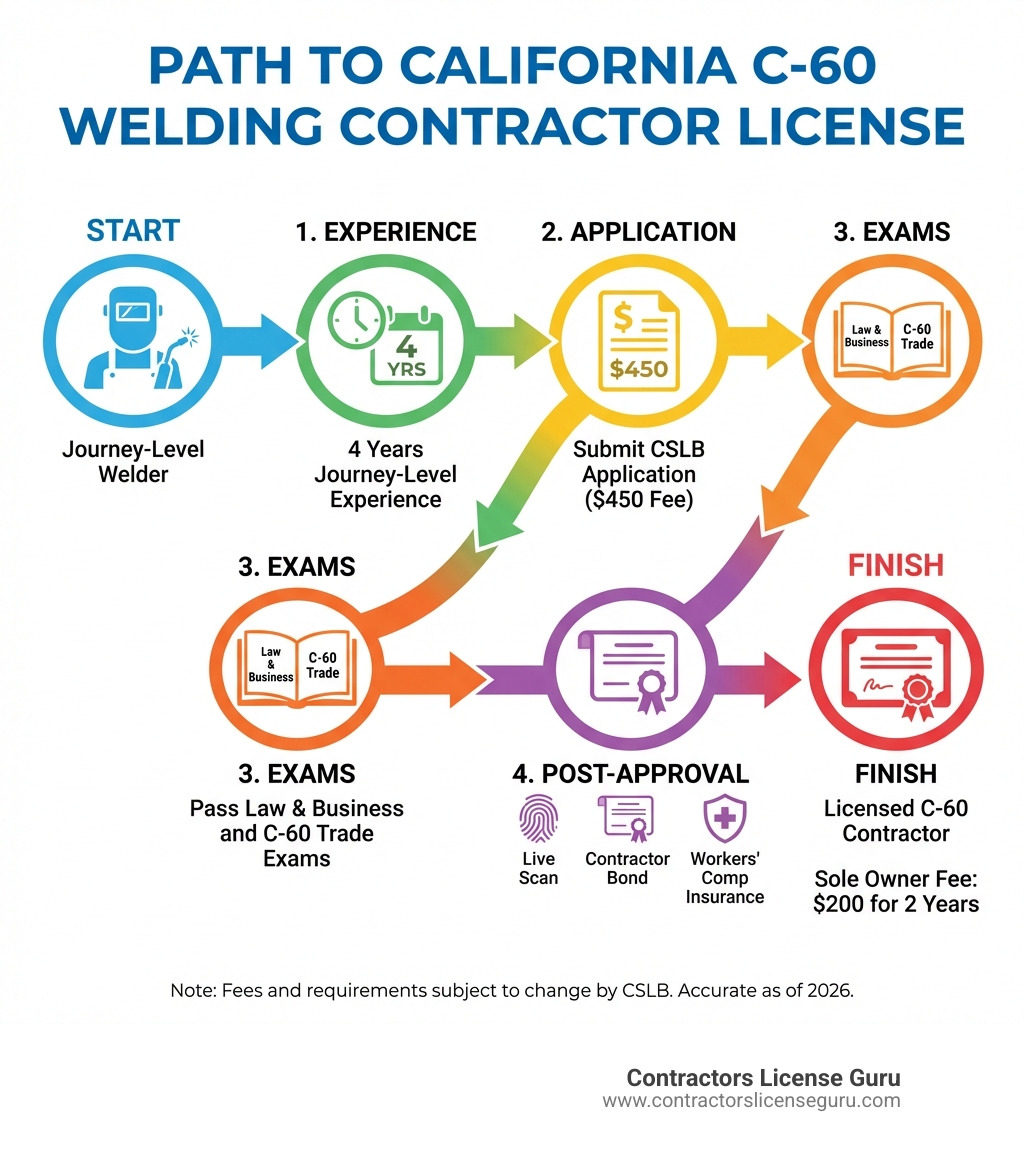
Here is a quick overview of what it takes to get a C-60 license:
California does not issue a state contractor license to individual welders simply for performing welding as an employee. But if you want to operate a welding contracting business — even as a sole owner — you need to understand when a C-60 license is required. If a project is $1,000 or more, requires a building permit, or uses employee labor, the minor-work exemption does not apply.
The process has real moving parts: experience documentation, closed-book exams, bonding, and more. It can feel overwhelming if you don’t know what to expect.
I’m Phil Cocciante, and I spent five years as a license application technician at the CSLB before founding Contractors License Guru — I’ve helped thousands of contractors navigate the exact California welding contractor license process you’re about to start. In this guide, I’ll walk you through every step so you can move forward with confidence.
In California construction, the CSLB divides work into various “buckets” or classifications. The California welding contractor license, officially designated as the C-60, has a very specific legal definition. According to the California Code of Regulations, a welding contractor is someone who causes metals to become permanently attached, joined, and fabricated through the use of gases and electrical energy. This process creates temperatures of sufficient heat to perform the thermal joining of metals.
While that sounds like a mouthful, it essentially means if your primary business is fusing metal together using heat—whether via MIG, TIG, Stick, or Flux-core—you fall under this category. It’s important to distinguish this from other similar trades. We often see applicants confused about whether they need a C-60 or something else.
For example, if you are strictly building the skeleton of a skyscraper, you might actually need a C-51 Structural Steel Contractor license. If you are making decorative railings and gates, you might look at the C-23 Ornamental Metal Contractor classification.
| Classification | Primary Focus | Key Difference |
|---|---|---|
| C-60 Welding | Permanent joining and fabrication of metals using heat. | Focuses on the process of welding across various industries. |
| C-51 Structural Steel | Fabrication and erection of structural steel shapes and plates. | Specific to the load-bearing structures of buildings. |
| C-23 Ornamental Metal | Non-structural, decorative metal work like fences and balconies. | Focuses on the aesthetic and safety features of metal. |
To dig deeper into how these interact, you can check out our California Contractors License Classifications page.
Obtaining your California welding contractor license is a marathon, not a sprint. The state of California wants to ensure that anyone running a business and performing potentially dangerous work has the “chops” to do it safely and correctly.
First, let’s talk about the baseline “must-haves.” You must be at least 18 years old. You also need a valid Social Security Number (SSN) or an Individual Taxpayer Identification Number (ITIN). Gone are the days when you could fly under the radar; the CSLB checks these against state records.
The biggest hurdle for most is the experience requirement. You need to prove that you have at least four years of journey-level experience within the last ten years. “Journey-level” means you can perform the work without supervision—you have the experience and skill to get the job done right the first time.
If you’re wondering if your specific background counts, our California Contractor License 101 guide breaks down the general entry requirements in even more detail. You can also find occupational license information for welding contractors in the US to see how California’s standards compare to the rest of the country.
When you fill out your application, you can’t just say “I’ve been welding for a while.” The CSLB requires a detailed “Work Experience” section. This must be verified by a qualified individual—usually a former employer, a fellow licensed contractor, or another qualified individual who has first-hand knowledge of your skills and experience.
Here is what we recommend for documenting your four years:
In some cases, you might qualify for an exam waiver. For instance, if you’ve been a “qualifier” on another license in good standing for five of the last seven years, you might qualify to skip the test. You can read the official 7065.1 Waiver provisions to see if you fit the criteria.
The CSLB application processing team is very thorough. If your experience looks thin or “fluffed,” they will return it for clarification, which can add months to your wait time.
Once your application is approved, it’s time to face the exams. To get your California welding contractor license, you must pass two separate tests:
These exams are closed-book and taken on a computer at one of the state’s testing centers. You won’t be able to bring your AWS handbook in with you! This is where many great welders fail—they know how to weld, but they haven’t brushed up on the technical terminology or the specific California laws.
We highly suggest using a C-60 Welding Contractor License Exam Prep Course and a Law and Business Contractors Exam Study Kit to prepare. Don’t wing it. The state charges a re-exam fee if you fail, and it delays your license. For more tips on the testing environment, visit our page on CSLB Exam Preparation.
Let’s talk about the “damage” to your wallet. Getting licensed isn’t free, but it’s an investment in your future earning potential.
The application for original contractor license fee is $450. This fee is non-refundable and covers the processing of your application and your first exam attempt.
Once you pass your exams, you aren’t done yet. You’ll need to pay an initial license fee. For a sole owner, this is currently $200 for a two-year period. If you are forming a corporation or a partnership (non-sole owner), that fee jumps to $350.
Here is a quick breakdown of the steps:
For a deeper dive into the CSLB license classifications, check out A Complete Guide to California’s CSLB License Classifications. You can also find more data on the License Info, California LaborMarketInfo portal.
Passing the test is a huge milestone, but the CSLB won’t issue an active license until you complete the applicable issuance requirements. These can include:
You also need to complete your Live Scan fingerprinting. This is how the state conducts the required criminal background check. Having a criminal history does not automatically mean an application will be denied, but applicants need to provide accurate information when required.
If you are adding a classification to an existing license, you might look into 7065.2 Waiver provisions to see if some of these steps can be streamlined.
We get a lot of questions at Contractors License Guru. Here are the most common ones regarding the California welding contractor license.
This is the number one point of confusion.
Think of it this way: the AWS cert proves you can weld. The C-60 gives you the contractor license needed to operate within the classification when California licensing law applies.
For minor work, the exemption applies only when all three conditions are satisfied: the combined project cost is less than $1,000, the project does not require a building permit, and no employee labor is used. If the project reaches $1,000 or more, requires a permit, or uses employee labor, the exemption does not apply regardless of how many AWS certifications you have.
As mentioned, you need four full years (48 months) of qualifying experience. This experience must be at the journey-level or higher, such as foreman, supervisor, contractor, or qualifying owner-builder experience.
Beyond the initial $450 application and $200 initial license fee, you have to maintain the license.
The demand for skilled welders in California is through the roof. With welding remaining an essential trade across construction, fabrication, manufacturing, infrastructure, and other industries, getting properly licensed can open the door to taking on contracting work of your own.
Obtaining your California welding contractor license is the key to unlocking those higher-tier projects and building a legacy for yourself. Yes, the paperwork is tedious and the exams are tough, but that’s what keeps the “trunk-slammers” out and keeps the professional standards high.
At Contractors License Guru, we live and breathe this stuff. Whether you need help with your application or you’re looking for more information about waiver application preparation services, we are here to help you get that “Active” status from the CSLB.
Ready to stop working for someone else and start building your own empire? Let’s get to work.