
Last updated: August 31st, 2026
The CSLB C20 license is California’s specialty contractor license for warm-air heating, ventilating, and air-conditioning (HVAC) professionals. Here’s what you need to know:
Quick Facts:
California’s minor-work exemption applies only when all three conditions are met: the combined value of labor, materials, and all other project costs is less than $1,000, the project does not require a building permit, and no employee labor is used.
If the project reaches $1,000 or more, requires a permit, or uses employee labor, the exemption does not apply.
This isn’t just a bureaucratic formality. The C-20 is an important credential for contractors who want to legally operate an HVAC contracting business in California.
The HVAC field also continues to show strong national demand. According to the U.S. Bureau of Labor Statistics, employment of heating, air conditioning, and refrigeration mechanics and installers is projected to grow 11% from 2025 to 2035, much faster than the average for all occupations.
Without the required license, you risk serious penalties for unlicensed contracting. With it, you gain credibility, access to qualifying projects, and the ability to build a legitimate contracting business.
The path to obtaining your C20 license involves meeting experience requirements, passing applicable state examinations, securing a contractor bond, maintaining required workers’ compensation coverage, and completing several administrative steps. While the process can seem overwhelming, understanding each requirement and preparing properly makes it manageable.
I’m Phil Cocciante, owner of Contractors License Guru and former CSLB application technician with over 20 years of construction industry experience. I’ve helped thousands of contractors successfully navigate the CSLB C20 license application process, from verifying experience to determining exam waivers and ensuring every form is completed correctly.
The CSLB C20 license is California’s specific classification for a Warm-Air Heating, Ventilating, and Air-Conditioning Contractor.
The Contractors State License Board (CSLB) defines a C-20 contractor as one whose principal contracting business involves fabricating, installing, maintaining, servicing, and repairing warm-air heating systems, water heating heat pumps, ventilating systems, and air-conditioning systems, including related components.
Why is this so crucial?
HVAC systems are complex and directly affect comfort, indoor environments, energy use, and building systems. California requires contractors performing work within this classification to satisfy CSLB’s applicable licensing requirements.
For minor projects, remember that price alone does not determine whether a contractor license is required.
The exemption applies only when:
If any one of those conditions is not satisfied, the minor-work exemption does not apply.
For a deeper dive into what this classification covers, see A Complete Guide to the C20 License for HVAC Contractors in California.
So, what exactly can you do with a CSLB C20 license?
A C-20 contractor is authorized to handle the fabrication, installation, maintenance, servicing, and repair of systems and components within the classification, including:
The classification also includes systems utilizing solar energy for heating, ventilating, and air-conditioning functions.
You can always review CSLB’s current license-classification definitions for the official scope.
In California, contractor licenses are broadly divided among General Engineering (Class A), General Building (Class B), Residential Remodeling (Class B-2), and Specialty (Class C) classifications.
The CSLB C20 license falls within the Specialty Contractor category.
A General Engineering Contractor (Class A) typically works on fixed works requiring specialized engineering knowledge.
A General Building Contractor (Class B) performs work involving structures and is subject to specific rules involving framing, carpentry, and multiple unrelated building trades.
A Specialty Contractor such as a C-20 contractor focuses on a specific trade requiring specialized skill.
For an HVAC contractor whose principal business involves the systems covered by the C-20 classification, the C-20 is the specialty license designed for that scope of work.

Before you can hold a CSLB C20 license, you need to meet CSLB’s applicable eligibility requirements.
Here are the basic requirements:
“Journey-level experience” generally means you have the experience and skills necessary to perform the trade without supervision.
CSLB requires your claimed experience to be certified by a qualified and responsible person who has firsthand knowledge of the work you performed.
Depending on your circumstances, this could include an employer, fellow employee, journeyman, contractor, union representative, building inspector, architect, engineer, or another qualified person with direct knowledge of your work.
Be prepared to provide supporting documentation if CSLB requests verification of the experience claimed on your application.
Relevant education may provide credit toward part of CSLB’s experience requirement.
The amount of credit depends on the education, degree, coursework, classification, and CSLB’s current experience-credit rules.
Applicants should submit appropriate documentation, such as official transcripts, when requesting education credit.
However, don’t assume that education automatically replaces the entire practical-experience requirement. CSLB evaluates qualifying experience and education under its applicable licensing rules.

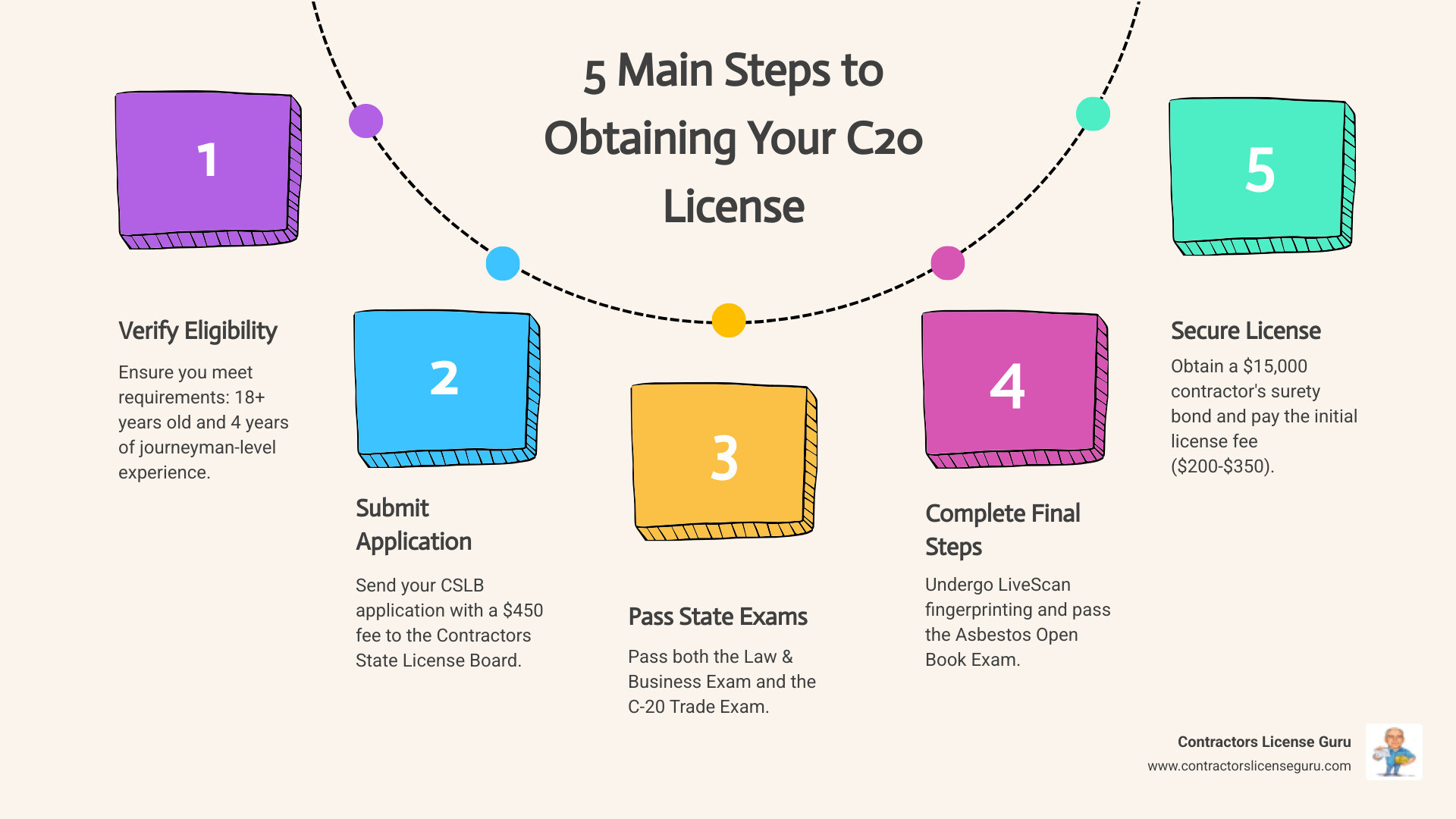
Obtaining your CSLB C20 license involves several stages, from submitting your application to satisfying CSLB’s final issuance requirements.
The amount of time the process takes varies.
Application processing depends on CSLB workload, whether your application is complete, whether experience verification is required, exam scheduling, and whether CSLB requests corrections or additional information.
Instead of relying on a static timeline in a blog article, check CSLB’s current processing times for the latest information.
Your first official move is submitting the appropriate contractor license application to CSLB.
A critical part of the application is accurately documenting your qualifying HVAC experience.
Your experience must be certified by a qualified and responsible person with firsthand knowledge of the work you performed.
Be prepared to provide supporting documentation if CSLB requests verification.
The original application fee for one classification is currently $450.
Before submitting your application, review everything carefully. Incorrect dates, incomplete experience descriptions, and other errors can delay CSLB processing.
Once your application is accepted and you are required to take examinations, CSLB will provide instructions for scheduling.
Most C-20 applicants who do not qualify for an examination waiver will need to pass:
Exam waivers or exemptions can apply in certain circumstances, so not every applicant will necessarily have identical examination requirements.
For examinations scheduled on or after April 1, 2026, CSLB’s current C-20 study guide divides the examination into four major sections:
1. Planning and Estimating — 22%
2. Fabrication, Installation, and Startup — 38%
3. Troubleshooting, Repair, and Maintenance — 20%
4. Safety — 20%
Exam percentages are approximate and based on CSLB’s current C-20 examination study guide for examinations scheduled on or after April 1, 2026.
The C-20 Trade examination is closed-book and multiple-choice. Some questions require mathematical calculations, and a calculator is provided.
The Law and Business Examination covers subjects related to operating a contracting business in California, including licensing, contracts, employment requirements, business finances, safety, and other contractor-law topics.
We highly recommend using current study materials built around the applicable CSLB examination guides.
You can also read Passing the California C-20 License Exam: What to Expect & How to Prepare for more information on preparing for the C-20 exam.
Congratulations—you passed the examinations required for your application.
You’re almost there.
Before your CSLB C20 license can be issued on active status, CSLB will notify you of the remaining issuance requirements applicable to your license.
These can include:
Once CSLB confirms that all applicable issuance requirements have been satisfied, your license can be issued.
Understanding the financial investment required to obtain and maintain your CSLB C20 license is important for business planning.
Common expenses can include:
Exact expenses can change, so check current CSLB fees and obtain current insurance and bond quotes rather than relying solely on estimated figures.
Getting your CSLB C20 license is a significant achievement, but maintaining it requires ongoing compliance.
Here’s what you need to do:
Maintaining these requirements keeps your CSLB C20 license in good standing and allows you to continue contracting legally.
Once you’ve completed the process and obtained your CSLB C20 license, the license can create substantial opportunities for your HVAC contracting business.
Here’s why:
BLS also projects about 40,000 openings per year over the decade as workers enter, leave, and move within the occupation.
These are national employment projections for HVAC mechanics and installers—not a guarantee of business growth or earnings for individual California contractors—but they provide useful context for the broader labor market.
For examinations scheduled on or after April 1, 2026, CSLB’s C-20 examination study guide lists four main areas:
The percentages are approximate.
Always use the current CSLB C-20 study guide when preparing because examination content and weighting can be updated over time.
Performing HVAC contracting work without a required CSLB C20 license can lead to serious consequences.
Remember that the exemption is not simply “jobs under $1,000.”
For the minor-work exemption to apply:
All three conditions must be satisfied.
A larger project also cannot be divided into smaller contracts to evade contractor licensing requirements.
Consequences of unlicensed contracting can include:
It’s simply not worth the risk. Make sure you understand whether your work requires a contractor license before bidding or contracting.
Yes.
This is an important rule specific to several California contractor classifications.
Active C-20 Warm-Air Heating, Ventilating and Air-Conditioning contractors are required to carry workers’ compensation insurance or a valid Certification of Self-Insurance even if they have no employees.
C-20 contractors cannot use CSLB’s standard no-employee workers’ compensation exemption.
This is different from many other contractor classifications, where a contractor with no employees may be eligible to file an exemption.
California requires an active contractor to maintain a $25,000 Contractor’s Bond.
According to CSLB, the bond is filed for the benefit of:
The bond is not the same as liability insurance, and it should not be described as a guarantee that a contractor will finish a particular job.
If your work involves servicing, maintaining, repairing, or disposing of equipment in a manner that requires handling regulated refrigerants, federal EPA Section 608 certification requirements can apply in addition to your CSLB C20 license.
EPA Section 608 technician certifications include:
Which certification you need depends on the equipment and work you’re performing.
The C-20 is your California contractor classification. EPA Section 608 certification is a separate federal requirement relating to refrigerant work.
The journey to obtaining your CSLB C20 license can seem challenging, but understanding the process makes it much easier to navigate.
The key is getting the details right:
We understand that navigating CSLB experience requirements, applications, examinations, bonding, and final issuance requirements can feel like a maze.
That’s where Contractors License Guru comes in.
As experts in California contractor licensing, we’re here to guide you through the process and help make sure your application is prepared correctly.
Ready to take the next step? Read our complete How to Get a Contractor’s License in California guide and let us help you move toward your C-20 license.